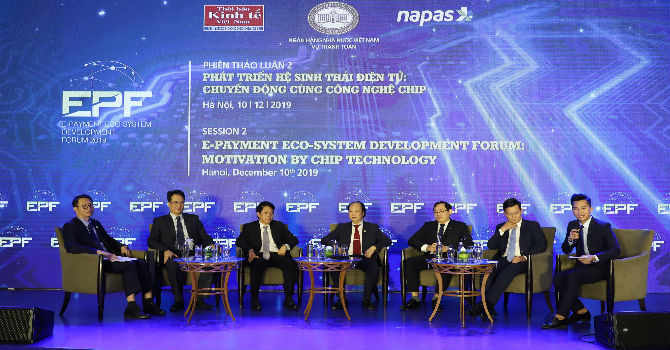
Will Vietnam be lagging behind the world when it is not until 2 years before completing the conversion to chip cards, while countries in the world have been put into use for a long time?
“Definitely costly.”
Speaking at the Forum of development of electronic payment ecosystem 2019 with the theme “Moving with chip technology” by Vietnam Economic Times, the State Bank and National Payment Corporation (Napas) Organizing on the morning of December 10, Deputy Prime Minister Vu Duc Dam said that, recently, the Politburo had a Resolution on Industrial Revolution 4.0, and the Government also had many resolutions, strategies, directives and decisions of the Government. How can the Prime Minister make good use of this opportunity?
The Deputy Prime Minister emphasized that the promotion of cashless payment is not as simple as it used to be to increase the circulation of capital throughout the society, not to let the currency die, not only to be a transparent issue against laundering. Corruption money, if done well, will boost the internet economy.
Between chip technology and old magnetic card technology, besides talking about cards, the transition, according to the Deputy Prime Minister, if we go straight ahead, we will not miss the beat.
“We are slow now. And to do this, you need to call not only regulatory agencies but also businesses.
The conversion is definitely expensive. But if it is good for the country, good for the society, that cost in the long run will offset the economic value it deserves. More importantly, it is the social responsibility of enterprises and banks ”, Deputy Prime Minister emphasized.
From the perspective of the banker, Mr. Nguyen Dinh Thang, Chairman of LienvietPostbank Bank said that, to convert from magnetic card to chip card, the bank cost will be very large. Technology investment needs to have a depreciation period, while when applying a chip card, the system of technology must change, the terminal system, ATM, POS system must also change … Those are Huge cost. In addition, changing chip cards back for customers also takes time.
Sharing the same view, Mr. Tran Cong Quynh Lan, Vietinbank Deputy General Director, said that the biggest challenge for banks in converting from magnetic cards to chip cards is the cost.
When deploying chip cards, banks will have to replace a series of machines, chip card issuance costs are also much higher than magnetic cards. However, we all recognize the need to transform, at the same time, turn challenges into opportunities. Chip cards can integrate, store a lot of information for customers, synchronize payment of many costs such as transportation, health, education, …
Two years from now, will Vietnam be a low point?
According to the roadmap outlined in Circular No. 41/2018 / TT-NHNN dated December 28, 2018, Vietnam will complete the conversion of 100% of domestic cards to chip cards by December 31, 2021.
The remaining time, which is only 2 years right. However, speaking to the sidelines reporter, Mr. Dao Minh Tuan, Chairman of the Vietnam Bank Card Association, said that the conversion in the past time has not been as expected as only about 10% of the amount Card is replaced.
And the question is, whether Vietnam will lag behind the world or not when it will take two years to complete the conversion to chip cards while countries around the world have put into use for a long time and technology. it always changes incessantly (?).
Answering this question, Mr. Tuan said that it is true that technology is always changing, however, chip cards are just the foundation.
“In the next 2 years, with the development of the chip platform, along with the value-added services on the chip system, the integration of information and applications on the card, banks will increase many other services, combining many other utilities such as health care, education on bank cards, ”Mr. Tuan said.
Meanwhile, citing figures from Mastercard International, Ms. Nguyen Tu Anh, President of National Payment Joint Stock Company (Napas), said that the growth rate of chip cards in the world has been very good for many years. , and forecasts for 2020 to maintain the growth rate of 40%.
“We don’t think the card will stop growing. However, the electronic payment ecosystem will not deny the role of e-wallets or QRs. All of these are new technologies, we can apply them to Vietnam market.
In the world, chip payment cards currently account for about 90% but in Asia is only 60%, Vietnam therefore, not too backward compared to the world.
The story of Vietnam’s transformation today for the next 3 years will have a lot of work to do and there will be a huge space waiting for the banking industry as well as other economic sectors to develop together, ”said President Napas. positive.
According to Ms. Tu Anh, Napas has so far granted standard certificates to most banks in the market. To support the growing market, Napas has also provided certificates for many white card providers and POS devices for the market so that the banking market has the best options when converting cards. and expanding its bank’s network of merchants.
“We want the story of the chip card application not only for the banking sector alone, because the chip card is a multi-application on which, besides the application for payment and financial services, it can be applied. adding links with other economic sectors to bring multi-applications into technology such as transportation, health insurance, social insurance … ”, said President Napas.
Obviously, the story of acceptance network expansion is a very big story for the whole market, because the card has already been issued but the card acceptance network must be invested and this investment is not small.
However, as Deputy Prime Minister Vu Duc Dam also said, this is the responsibility of the banking industry in particular and other ministries in general to the community.
With this investment, it is expected that people will be able to carry out comprehensive financing, the poor in rural areas will also be able to use banking technology in payment and in financial services in the near future.
(Source: BIZLIVE)
Tin tức khác

Chuyển đổi thẻ từ sang thẻ chip: Mục tiêu của ngành ngân hàng năm mới
Theo mục tiêu được Chính phủ đặt ra, đến năm 2020 tỷ lệ thanh toán không dùng tiền mặt phải chiếm hơn 30% trên tổng phương tiện thanh toán tại Việt Nam. Chuyển đổi thẻ từ sang thẻ chip với công nghệ bảo mật an toàn hơn là yêu cầu bắt buộc. Việc chuyển đổi
Xem chi tiết
Ngân hàng chuyển mình trong cuộc đua số hóa
Nam A Bank đưa robot, trợ lý ảo phục vụ khách hàng, đồng thời hoàn thiện hệ sinh thái eBanking, mang đến trải nghiệm đa tiện ích cho khách hàng. Trong bối cảnh công nghệ phát triển, ứng dụng ngân hàng số là lựa chọn tất yếu của các nhà băng, nhằm cung cấp những
Xem chi tiết
Thanh toán không dùng tiền mặt qua Napas tăng 48%
Cơ cấu giao dịch thông qua hệ thống NAPAS có sự dịch chuyển từ chuyển mạch ATM sang thanh toán liên ngân hàng tăng lên 48%. Tại Hội nghị tổng kết hoạt động năm 2019 của Công ty Cổ phần Thanh toán Quốc gia Việt Nam (NAPAS), ông Nguyễn Quang Hưng, Tổng Giám đốc NAPAS
Xem chi tiết
Cảnh giác mánh siêu lừa, hack tài khoản trộm tiền trong ngân hàng
Gần đây, xuất hiện một số thủ đoạn mới nhằm trộm tiền trong tài khoản ngân hàng. Do đó, mọi người cần hết sức cẩn thận trong giao dịch ngân hàng, nhất là vào dịp cuối năm, thời điểm các đối tượng phạm tội gia tăng hoạt động. Giả mạo tin nhắn thương hiệu Trước
Xem chi tiết
Top 10 most typical IT events in 2019
TTO – Revolution 4.0, E-Government, AVG trial, 5G network testing … were voted as the top events in the top 10 ICT 2019 events Top 10 most typical IT events in 2019 – Photo 1. In 2019, Vietnam announced the strategy of “Make in Vietnam” with the goal of proactively, creating, designing, integrating products in
Xem chi tiết
Ngân hàng phải báo cáo định kì kết quả chuyển đổi thẻ từ sang thẻ chip
NHNN đề nghị các tổ chức phát hành, thanh toán, chuyển mạch thẻ điện tử…nghiêm túc tổ chức triển khai áp dụng tiêu chuẩn cơ sở thẻ chip nội địa. Ngân hàng nhà nước Việt Nam (NHNN) vừa có văn bản đề nghị các tổ chức phát hành thẻ, tổ chức thanh toán thẻ, tổ
Xem chi tiết