Users can register to open a remote account, one-touch payment on mobile
In the context of the outbreak of Covid-19, cash is considered to be one of the means that can infect the community with viruses. In fact, in Vietnam, electronic payment by bank cards (NH) is still not very popular, but intermediaries such as e-wallets and mobile accounts are easy to use.
Pay by phone number
The Government’s Resolution No. 02 / NQ-CP of January 1, 2020 on continuing to carry out the main tasks and solutions to improve the business environment and enhance the national competitiveness in 2020 has been determined promoting non-cash payment is one of the central areas of reform to further improve the business environment and enhance national competitiveness. The Government requires functional ministries and agencies to perfect the legal corridor, allowing people and businesses to pay without using cash by many different means.
The new point that many people expect is mobile payment. Resolution 02 / NQ-CP has assigned the State Bank to assume the prime responsibility for, and coordinate with the Ministry of Justice and relevant agencies in, studying and proposing the Prime Minister to issue a decision on the pilot use of telecommunications accounts. to pay for small-value services (Mobile-Money), to pilot new payment service models while there is no law to promptly ensure management, especially for cross-border payment activities, completed in the fourth quarter.
The Governor of the State Bank also issued Directive 01 / CT-NHNN on organizing the implementation of key tasks of the banking industry in 2020, in which the requirement to promote non-cash payment. The instruction stated: “Innovating and completing information technology infrastructure, applying modern technology to develop digital banking services; enhancing security, safety and security in banking activities”.
In the new decree replacing Decree 101/2012 / ND-CP on non-cash payments, telecom operators will also be provided with separate payment services and user identification with phone numbers, or into a payment intermediary channel. Enterprises that provide electronic payment services, instead of being shy about the state management, will boldly deploy it.
Due to its characteristics, different types of intermediaries are more accessible to people. Regardless of the simpler process of participation, these services are also wide-ranging to have promotions and incentives that bring many benefits to its customers. By mid-11-2019, 32 non-bank organizations have been licensed by the State Bank to provide intermediary payment services.
Comfortable and safe
For the type of electronic payment outside the bank, two core factors that users care about are comfort and safety. Since the Lunar New Year so far, the children have been absent from school, Ms. Mai Van (living in Thu Duc District, Ho Chi Minh City) regularly buys products online, from e-commerce platforms to online sales channels of businesses. , group sales through social networks in the apartment … she took full advantage. From toys, housewares, food, she all buy online, pay via bank cards or electronic wallets.
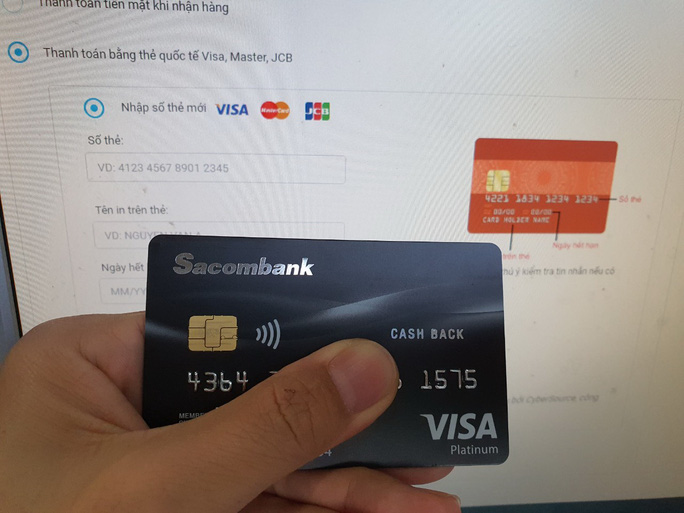
Many banks are constantly investing in infrastructure for connecting, deploying new payment channels via QR Code, contactless cards, besides paying online via domestic cards, credit cards. , Internet Banking, Mobile … Mr. Nguyen Minh Tam, Deputy General Director of Saigon Thuong Tin Commercial Joint Stock Bank (Sacombank), said that this bank is continuing to strengthen and complete the connection of more non-cash payment methods. While the translation of Covid-19 is still complicated, customers can register to open a remote account, the electronic authentication method (eKYC) will be applied, extend payment via QR code, one-touch payment on mobile. … towards the convenience of users. “For about two years now, when banks launched contactless cards (both domestic and credit cards) and many POS machines later invested also integrated the card reader, which helps cardholders not need touching but still paying, limiting direct contact, especially when there is an epidemic “- Mr. Nguyen Minh Tam analyzed.
Sacombank has pioneered the implementation of contactless payment technology and QR payment in accordance with international standards with the goal of optimizing utilities, increasing security and reducing payment time for cardholders. Contactless cardholders only need to touch a contactless card on a POS device with this technology for a few seconds to complete the transaction and do not need to sign invoices from VND 1 million or less. About 60% of Sacombank’s POS machines have also applied this touch technology. Sacombank has also issued a domestic card line equipped with EMV chip that allows contactless payment transactions (100% of chip cards issued as contactless), scanning QR codes on mobile phones instead of using plastic cards directly …
Not only commercial banks, but also many units that provide goods and services such as technology calling companies, taxis, e-commerce floors, large enterprises, etc. also encourage customers to directly link bank accounts with member card number of businesses to increase utilities in payment. Vietnam National Payment Joint Stock Company (Napas) is supporting commercial banks to convert domestic cards (magnetic technology cards) into VCCS chip cards according to the roadmap, connecting with other sectors such as transportation. , Health Insurance and Social Insurance help people use their cards for essential needs payments.
Tin tức khác

Payment without cash: It is difficult for banks to transfer magnetic cards to chip cards
Chip cards enable local card issuers to expand their payment ecosystem into industries such as transport health and insurance. But banks say that converting magnetic cards to chip cards will incur additional costs. Converting domestic payment cards from magnetic cards to chip cards is one of the tasks approved by the Prime Minister in the
More
Forum on developing electronic payment ecosystem 2019 “Moving with chip technology”
On December 10, 2019 in Hanoi, Vietnam Economic Times, Vietnam National Payment Company (NAPAS) and the Payment Department – The State Bank chaired the organization of the Forum on payment ecosystem development. Electronic 2019 with the theme “Motion with CHIP technology” (EPF 2019). Deputy Prime Minister Vu Duc Dam, Deputy Minister of Health Truong Quoc
More
The bank changes itself in the digital race
Nam A Bank offers robots and virtual assistants to serve customers while simultaneously improving the eBanking ecosystem, providing a multi-utility experience for customers. In the context of technology development, digital banking application is an indispensable choice of banks, in order to provide safe, effective financial services to meet the diverse needs of users. This is
More
Payment contactless
Contactless (contactless) by waving, tapping on the POS machine to pay, is a trend of non-cash payment is being used by many people, in addition to local swipe cards, international cards and Payment by QR code via mobile devices. This form is well received not only for its style and convenience, but also for its
More
Từ 2020, không cần giấy tờ tùy thân khi khám chữa bệnh BHYT
Đã nhiều năm, chứng minh nhân dân hay các giấy tờ tùy thân khác là một phần không thể thiếu của hồ sơ khám, chữa bệnh bảo hiểm y tế. Tuy nhiên, từ năm tới, khi đi khám, chữa bệnh, người dân đã có thể bỏ qua loại giấy tờ này. Thủ tục khám chữa
More
Conversion of chip cards – one of the major goals of the State Bank
According to the SBV’s roadmap specified in Circular No. 41/2018 / TT-NHNN, by the end of 2020, 100% of ATMs and card acceptance devices at point of sale operating in Vietnam of card payment institutions must Comply with local standard chip card. The first domestic chip cards from Vietnam were officially launched on May 28,
More