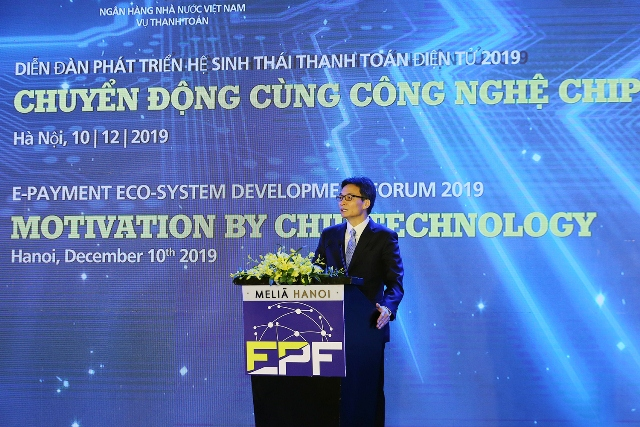
Deputy Prime Minister Vu Duc Dam said that the Government has instructed industries such as tax, insurance, telecommunications and electricity to apply non-cash payments …; in which two fields, education and health, must be implemented before 2020.
At the Forum of developing electronic payment ecosystem 2019 with the topic “Moving with chip technology”, Deputy Prime Minister Vu Duc Dam reiterated the story of Vietnam Post has bravely went straight to the 2G network, even in other countries. nearby free technology transfer is more backward. As a result, Vietnam is one of the pioneers in 2G technology.
“Similarly between current chip and magnetic card technology, if we boldly take a step forward, we will not miss the beat” – Deputy Prime Minister exchanged in the Forum of Electronic Payment Ecosystem Development 2019 .
Deputy Prime Minister said, the Government has directed the sectors such as tax, insurance, telecommunications, electricity to apply non-cash payments …; in which two fields, education and health, must be implemented before 2020.
“Now a lot of farmers and poor people still think that bank accounts are not for themselves, changing this mindset is the duty of the State Bank, the banking system, credit institutions, the media … “, Deputy Prime Minister noted and said that it is necessary to strongly apply technology, proceed to integrate personal information about personal identity, health insurance, social insurance, banking … at the same time, coordinate the contract. ministries among ministries, organizations, enterprises, mobilizing and explaining for people to participate.
“Vietnamese people have a saying that“ money comes with their intestine ”, therefore, the issue of safety and security in payment to the people is the most practical thing. Therefore, in order to promote electronic payment, to take advantage of the digital economic opportunity, we need to attach it to safety and security and make sure the benefits of participation for all citizens “- Deputy Prime Minister Vu Duc Dam to speak.
Experts said that promoting electronic payment towards cashless society is an inevitable development trend in the context of the Fourth Industrial Revolution, creating a double impact that has spurred economic growth. International financial assistance has supported the implementation of a comprehensive financial strategy through the universalization of banking and financial services.
According to the State Bank, as of September 30, the value of payment via POS increased by 36.5% over the same period; the number of cards reached 96.4 million; more than 19,000 ATMs … These are the basis for promoting electronic payment mobile banking and internet banking. However, the transition to chip cards is also new content, there are many challenges and challenges.
The main reason today is due to the large banking costs. Investing in old technology requires a period of depreciation, while when applying a chip card, the system of technology must change, the terminal system, ATM tree, POS system must change.
In addition, when switching to chip cards, banks have to change a series of machines, chip card issuance costs are also much higher than magnetic cards. However, banks have realized that it is necessary to convert and are determined to transfer magnetic cards to chip cards, turning challenges into opportunities with integrated, synchronous payment of many expenses such as education and health. , insurrance…
Up to now, there are more than 20 banks and 6 institutions providing chip cards, expected by the end of the first quarter of 2020, this figure will reach 26 banks, 10 companies providing chip cards …
(Source: Life Health Newspaper)
Tin tức khác

Thanh toán qua ví điện tử, làm sao để đảm bảo an toàn, tiện lợi?
Sử dụng ví điện tử thanh toán online thay cho tiền mặt đang trở thành xu hướng của người tiêu dùng Việt. Nhưng chính các loại ví công nghệ cũng đang là đích ngắm của các cuộc tấn công mạng… Ví điện tử là đích ngắm của hacker Theo ông Lê Anh Dũng – Phó
More
Chấp nhận ‘đội’ chi phí để khách hàng trải nghiệm dùng thẻ chíp
Theo yêu cầu của Ngân hàng Nhà nước (NHNN), đến cuối năm 2019, ít nhất 30% số thẻ ATM, 50% thiết bị chấp nhận thẻ (POS) tại điểm bán hàng đang lưu hành trên cả nước phải tuân thủ tiêu chuẩn cơ sở về tiêu chuẩn thẻ chíp nội địa. Tuy nhiên, vấn đề lớn
More
QR code payment – New trend of modern young people
At any location, even without carrying a wallet, cash or bank card, you can confidently pay the bill in a snap with QR code (payment by QR code) via mobile banking. This trend has become a modern payment trend for many young people today. “Very fast, every time I go out to eat and drink,
More
ACB has issued two new domestic chip card lines applying VCCS technology
In compliance with Circular 41/2018 / TT-NHNN, while increasing experience and improving the safety in domestic card transactions, ACB has issued two new domestic chip cards using VCCS technology: Chip cards. debit domestic with the name ACB Green and the domestic credit chip Card called ACB Express. ACB Green and ACB Express cards are applied
More
5 Golden rules to help you use your ATM card safely
Most ATM cards in use today mainly use magnetic technology. With this technology, the card information has been hacked and changed easily … The advent of ATM has created a major breakthrough, completely changing the trading habits of Vietnamese people. Until now, the ATM card has become a familiar tool, “the object of separation” with
More
Electronic payments spike in Covid-19
Users switch to payment via cards, mobile applications, QR codes … to increase safety and convenience in Covid-19, and enjoy incentives from the bank. Never used a banking application to pay bills, Ms. Thu Hong (District 8, Ho Chi Minh City), surprised by the convenience of this method. “The recent payment of utility bills, for
More