Vietnam is really moving ahead of more developed countries like Singapore and Malaysia in electronic payment, with the fastest mobile payment growth in the world, from 37% in 2018 to 61% in 2019.
“Within 6 years, the scale of the Vietnamese e-commerce market is expected to be the second in Southeast Asia. This is really an open opportunity for Mastercard to deeply implement initiatives to promote adoption and deployment. deployment of digital payment technology as well as the goal of non-cash in Vietnam, ”said Mr. Safdar Khan, a veteran member of Mastercard with the Vietnam News Agency correspondent when he has just taken the role of president of new markets. Floating Southeast Asia including Thailand, Indonesia, Myanmar, Cambodia, Laos and Vietnam.
Mr. Safdar Khan said that the governments of Southeast Asian countries have been strongly promoting cashless payment. In particular, the Government of Vietnam has taken positive steps to promote electronic payment services including credit and debit cards, e-wallets, mobile applications and electronic banking. These initiatives, coupled with high internet penetration and smartphone penetration in central cities, along with the development of e-commerce, e-wallets, an increase in income and consumption, created a vibrant market, contributing to digital payments.
“Based on the experience of Mastercard in other markets, we expect Vietnam to have faster conversion rate from cash to cashless payment,” said Safdar Khan.
Reporter: So sir, in order to continue promoting the market of cashless payment (NERC) Vietnam needs to come here? And where is the challenge?
– Mr. Safdar Khan: Business and commerce centers are thriving in Vietnam thanks to the popularity of mobile devices and the increasing use of e-commerce. A report by GlobalWebIndex – a market research firm with bases in 32 countries shows that 78% of Internet users in Vietnam aged between 16 and 64 have used to shop online. In 2018 alone, consumers in Vietnam spent about $ 6 billion on online shopping. According to the Payment Department of the State Bank of Vietnam, transactions via mobile applications in 2018 increased by 126%, while transactions via digital wallets increased by 161% – these are very remarkable figures. However, cash continues to be a familiar choice for consumers and businesses, especially in everyday transactions. The high level of cash usage also stems from the fact that businesses (especially small and medium-sized enterprises) are still reluctant to set up digital payments or do not fully understand the benefits of Trading center.
To solve this problem, I think that it is necessary to promote communication and disseminate to consumers about the benefits and outstanding security features of the department store, including digital payment. In addition, global payment technologies need to be integrated to help financial institutions continue to expand access to modern payment methods for both rural and remote residents. remote area.
At the same time, it is necessary to identify and implement initiatives to encourage end users to use digital payments for both low-value items daily to change behavior and habits. The promotion programs can be implemented under various forms of promotion such as gifting of movie tickets, coupons at e-commerce platforms, food ordering, online delivery or via price services. Added value for online booking applications. The use of digital payments will become easier and more familiar, which will gradually become part of everyday life, allowing for a faster and better transition to cashless payments.
Governments and payment service providers such as banks, fintech companies and Mastercard need to work together to promote cashless payment channels such as mobile selling points, QR codes, etc. In addition, all service providers need to propagate to businesses on digital payment to help businesses operate more efficiently and economically, allowing them at the same time. access to new customers.
Finally, it is necessary to create an open transit system in Vietnam. This plays an important role in our lives when we constantly have to go to work and return home every day. With an integrated compatible payment system, people will be able to take advantage of non-cash payment methods to travel, thus saving time and experiencing smoother and more convenient journeys. This will also allow transport operators to efficiently manage their supply and logistics, optimizing and even cutting costs.
Reporter: Sir, Mastercard “ambitious” created a new era of sustainable financial growth in Southeast Asia, promoting the cash-free economy in this region in general and in Vietnam in particular. . How will Mastercard realize this ambition?
– Mr. Safdar Khan: Our vision is always to create a world beyond cash, in which no one is left behind. This vision continues to drive us forward through our current efforts – in applying technology and expertise to make payments securely, simply and intelligently, at any time, at any time. anywhere.
We have been actively working and cooperating with partners in many different countries, in order to create a secure, easily accessible and convenient payment ecosystem where cash flows seamlessly from point A to B. In March, we became the leading investor in Series B funding round of Indonesian financial technology company (fintech) Digiasia, with both financial and strategic support to help Digiasia. Enhancing the financial services for small and medium-sized individuals and businesses with more options when participating in the developing digital economy in Southeast Asia.
We are also strongly committed to finding new and more innovative ways to help regional economies connect with customers in that country. So we decided to partner with Digiasia and similar companies in Vietnam, where financial services are making a significant difference in the lives of so many people.
We are always at the forefront of developing innovative security measures to protect cardholders, businesses and card issuing banks from fraudulent transactions, at a reasonable cost. Currently, Mastercard is using a range of technologies to ensure the security and safety of all transactions at all levels, including leading EMV Co standards such as tokens and authentication.
We are committed to working with and facilitating markets like Vietnam to create a world that is not limited by cash.
Reporter: Before you take on your new role in Southeast Asia, you used to be the Chairman of Mastercard in Indonesia, Malaysia and Brunei. What are the reasons for Southeast Asia including Vietnam to become the main market of Mastercard?
– Mr. Safdar Khan: Emerging markets in Southeast Asia are dynamic centers of growth and potential, where technology enthusiasts are embracing technology as a comprehensive and convenient means to meet. every need of the people. This is where economies and populations have a high digitization rate and currently contributes 6 of the world’s top 14 high-performance emerging markets.
This is an exciting time for Mastercard in Southeast Asia, where emerging markets such as Vietnam, Thailand …, are witnessing an exciting increase in digital technology for payment support. use cash. In Vietnam alone, as of September 2019, there were 59 million Internet users. In addition, more than half of the Vietnamese population is expected to transact digitally in the context of a soaring e-commerce market. In fact, Vietnam’s e-commerce market size is expected to be second only in Southeast Asia after Indonesia in the next 6 years.
Moreover, when looking at the ASEAN region, it can be seen that Vietnam has become a fintech center with Ho Chi Minh City. Ho Chi Minh City and Hanoi are the starting places for fintech and technology companies and in 2019 Vietnam received 36% of its investment in this sector. Many investors are now considering Vietnam as an important region for peer-to-peer (P2P) lending, credit scoring and mobile payments.
We have been actively working with stakeholders in countries like Indonesia to digitize wages, create access to financial knowledge for the poor, and improve people’s capacity for the digital economy. – all of these lessons and experiences will help us bring the best technology knowledge and qualifications to fast-growing markets like Vietnam.
-Source: Vietnam Financial Times-
Tin tức khác
Tích cực chuyển đổi thẻ từ sang thẻ chip
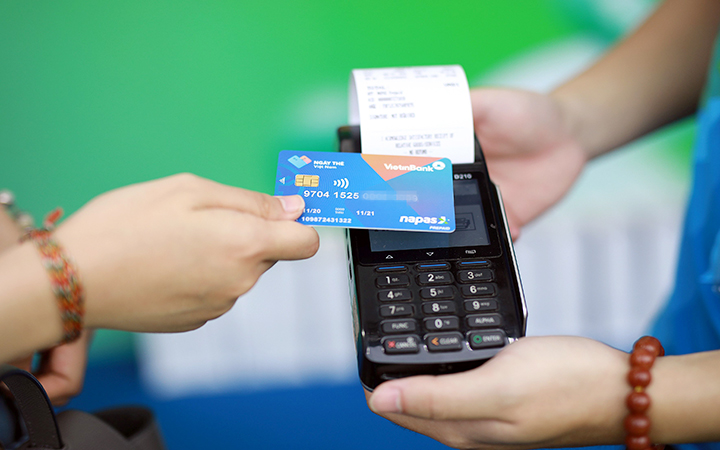
Xu thế hiện nay trên thế giới là chuyển đổi sang thẻ chip nhằm tăng cường an toàn bảo mật cho thẻ ngân hàng. Việt Nam cũng không thể nằm ngoài xu hướng này khi các ngân hàng đang có những động thái tích cực, triển khai áp dụng tiêu chuẩn thẻ chip nội địa
More
Rút tiền mặt từ thẻ tín dụng qua máy POS: Phạm pháp và nhiều rủi ro
Ngân hàng cần tuyên truyền để khách hàng biết rằng, không thể dùng thẻ tín dụng để rút tiền qua những giao dịch khống, vì điều đó là phạm pháp. Hiện nay, dịch vụ rút tiền mặt từ thẻ tín dụng đang rất phổ biến. Theo đó, có một số công ty có hợp đồng
More
The bank is racing using chip card technology
Banks are racing to use the technology to convert magnetic cards to chip cards. Accordingly, customers receive many benefits from domestic chip cards. Technology is constantly updating Switching cards from magnetic to chip technology is a requirement for commercial banks in the period 2020-2021. Ms. Nguyen Hong Van – Director of Vietcombank Card Center said
More
3D-Secure – secure technology for card transactions
With outstanding advantages of safety – security – convenience, 3D-Secure has been well received and used by Vietcombank cardholders. Recently, the Bank for Foreign Trade of Vietnam (Vietcombank) has invested heavily in technology systems, prioritizing the use of infrastructure and application of the most advanced, modern and most secure technology, ensuring transaction support. Card payment,
More
Thẻ Visa (Visa card) là gì? Các loại thẻ Visa và lợi ích của chúng
Thẻ Visa (tiếng Anh: Visa card) là một loại thẻ thanh toán quốc tế, do tổ chức Visa liên kết với các ngân hàng trong nước phát hành, nhằm mục đích dùng để rút tiền, mua hàng trực tuyến hoặc thanh toán tại các điểm chấp nhận trên toàn thế giới. Thẻ Visa (Visa card)
More
Nhiều tiện ích từ thẻ bảo hiểm điện tử
Theo lộ trình đã được đặt ra, từ ngày 1/1/2020, cơ quan bảo hiểm xã hội (BHXH) sẽ thực hiện việc cấp thẻ bảo hiểm y tế (BHYT) điện tử cho người tham gia. Nếu thẻ BHYT điện tử được phát hành, sẽ là bước đột phá của ngành BHXH, mang lại rất nhiều lợi
More