The conversion of magnetic cards to chip cards in Vietnam is quite slow. This invisible medium has helped criminals steal money from ATM cards.
Currently, Vietnamese banks are “racing” to convert magnetic cards to chip cards. This transformation not only fulfills the requirement of the State Bank (SBV) to be completed in 2020, but also to dominate customers, which are changing daily consumption habits.
Nguyen Quang Hung, general director of Vietnam National Payment Joint Stock Company (Napas), said that in May, only seven banks were willing to convert chip cards and five white card suppliers ( card embryo), but so far more than 20 banks are willing to convert and 6 units provide blank cards. Expected to quarter 1/2020, this number will reach 26 banks and 10 companies providing white cards.
However, many people believe that, compared to many countries in the world, the conversion of magnetic cards to chip cards in Vietnam is still quite slow. One of the main causes is cost.
The risk of losing money in ATMs increases because of the slow transfer of magnetic cards to chip cards
Converting a magnetic card to a slow chip card can lead to increased money loss. (Artwork: KT)
According to Mr. Nguyen Dinh Thang, Chairman of the Board of Directors of LienvietPostbank, investing in old technologies requires a depreciation period, while when applying the chip card, the core card system must change, the terminal system, the tree ATMs, POS systems must also be removed and invested in a new system to recognize the chip. Not to mention, changing the chip card also takes time for customers to adapt and get acquainted.
Sharing the same view, Mr. Tran Cong Quynh Lan, Deputy General Director of VietinBank, said that when changing to a chip card, the bank will have to change a series of machines, the cost of issuing a chip card is also higher than the one from many times. However, banks have found it necessary to convert magnetic cards into chip cards and how chip cards can be integrated and synchronized to pay for expenses such as insurance, education and health care. merely holding an ATM account.
While the issuance of domestic chip cards is slow, the criminal situation, especially foreign criminals, “hacking” customer accounts to steal money through skimming is on the rise.
Specifically, in November, the Ministry of Public Security in collaboration with the City Police Department (Nghe An) arrested three Chinese people to investigate the use of computers and telecommunications networks to seize assets. Authorities seized 333 counterfeit bank cards. Among them, 319 were scanned information about the account holder, 22 cards were withdrawn from the account and 14 blank cards, 3 sets of electronic devices, computers, memory cards, and many other related exhibits.
By sophisticated means of entering Vietnam to rent a hotel, they have installed “strange” devices into a bank’s ATM to steal customer card information. The information data was initially processed by the subjects and then transferred to China for decoding and transferred back to the above 3 subjects, pouring data into blank ATM cards into fake cards and then withdrawing money at ATMs …
According to economists, the technique of skimming money with skimming has appeared for many years in the world and Vietnam is considered a “key” of foreign criminals by using magnetic tape ATMs, while many Water has converted to chip cards.
Figures of the Global Organization for Management of EMV Specifications (EMVCo) show that, by the end of 2018, the global rate of ATM card transactions according to chip standards in the world accounted for 73.6%, particularly countries in Europe Asia has increased the rate to 68.15% instead of 54.4% in 2017. Some countries in the region have successfully converted to chip cards such as: Malaysia converted national cards by the end of 2018 and is implementing Phase 2 to EMV international standard chip. In Indonesia, convert domestic ATM chip cards 30% by the end of 2018, 50% by the end of 2019 and reach 100% by 2021 …
Finance and banking expert Nguyen Tri Hieu recommends that in the period when Vietnamese banks preparing to convert magnetic cards to chip cards may face many risks, because technology criminals take this opportunity to ” to penetrate ”into countries not yet able to convert to chip cards with higher security and confidentiality. Therefore, converting a magnetic card to a chip card is a necessary job, done as soon as possible to protect assets for both customers and banks.
For user safety, TS. Nguyen Tri Hieu also noted that card users must keep their cards secure. Regardless of whether a magnetic card or chip card when confidential information is leaked out, crooks can still use and appropriate money in the account. Along with that, consumers should change their passwords often to avoid having their passwords revealed.
(According to VOV)
Tin tức khác

Việt Nam sẽ sớm trở thành quốc gia không sử dụng tiền mặt
Đó là khẳng định của ông Safdar Khan, thành viên kỳ cựu của Mastercard, người vừa tiếp nhận vai trò Chủ tịch phụ trách các thị trường mới nổi khu vực Đông Nam Á của tập đoàn này. Theo Nikkei, tại châu Á, trong cuộc chiến thanh toán điện tử, Visa và Mastercard đang đối
Xem chi tiết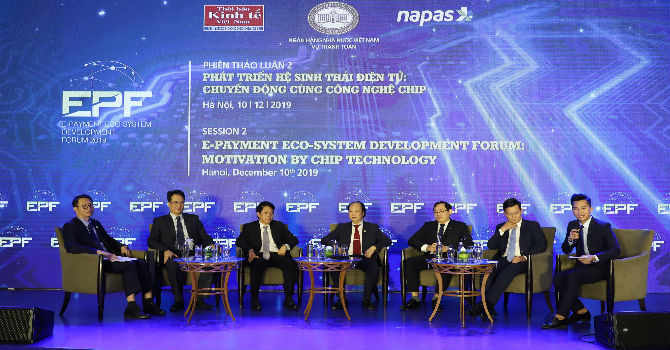
“Thanh toán điện tử giúp chống rửa tiền, chống tham nhũng”
“Thanh toán điện tử giúp chống rửa tiền, chống tham nhũng” Đó là khẳng định của Phó Thủ tướng Vũ Đức Đam trong Diễn đàn phát triển hệ sinh thái thanh toán điện tử năm 2019 với chủ đề “Chuyển động cùng công nghệ chíp” do Ngân hàng Nhà nước, Công ty Cổ phần thanh
Xem chi tiết
Ưu điểm của công nghệ bảo mật 3D-Secure 2.0
3D-Secure là lớp bảo vệ tăng cường cho chủ thẻ Vietcombank giúp tăng cường độ an toàn, bảo mật và thuận tiện khi giao dịch trực tuyến. Với phương thức này, khi thực hiện các giao dịch trên website thương mại điện tử, bên cạnh các bước xác thực thông thường, Vietcombank sẽ gửi thêm
Xem chi tiết
Cashless payment: Need drastic from the state management
Promoting cashless payments requires a specific solution, not just propaganda … “The challenge of slowing the transition from magnetic stripe to chip card, what’s the reason?” is the first issue raised during the discussion at the 2019 Electronic Payment Ecosystem Development Forum: Moving with Chip technology by the Vietnam Economic Times in collaboration with Vietnam
Xem chi tiết Two years from the end of converting chip card, Vietnam is a low point in the world?
Will Vietnam be lagging behind the world when it is not until 2 years before completing the conversion to chip cards, while countries in the world have been put into use for a long time? “Definitely costly.” Speaking at the Forum of development of electronic payment ecosystem 2019 with the theme “Moving with chip technology”
Xem chi tiết
Hàng loạt vụ trộm tiền trong “chớp mắt” và cảnh báo người dùng thẻ tín dụng
Liên tiếp các vụ tấn công “hack” thẻ visa để trộm tiền đang là nỗi lo lắng của nhiều ngân hàng và người dùng thẻ. Thủ đoạn tinh vi, lợi dụng người dùng sơ hở, bọn tội phạm đã đánh cắp thông tin tài khoản thẻ visa để thực hiện chiếm đoạt tài sản. Liên
Xem chi tiết